
In 2025, predictive analytics is evolving, driven by the growing demand for real-time insights to keep pace with rapidly changing marketplaces, transition from reactive to proactive business models, improve operational efficiencies, and better serve the needs of employees and customers.
At the core of this transformation are event-driven architectures and data-in-motion platforms, including things like Apache Kafka and Apache Flink. Systems based on these technologies process and analyze streaming data the moment it is generated. As such, these technologies provide the foundation for predictive models that operate in near real time, detecting anomalies, forecasting trends, and triggering automated actions instantly. As a result, industries such as manufacturing, finance, and healthcare are leveraging predictive analytics for use cases including predictive maintenance, fraud detection, and patient outcome forecasting.
Increasingly, artificial intelligence is starting to play a larger role in organizations’ predictive analytics efforts. Machine learning models are being embedded within data pipelines, learning from live data streams and adapting predictions on the fly. That enables businesses to manage complex, high-volume, and rapidly changing data without manual intervention.
See also: Beyond Kafka: Capturing the Data-in-motion Industry Pulse
What is the size of the predictive analytics market?
The predictive analytics market in 2025 is expected to be between $17 billion and $22 billion, with an anticipated annual growth rate of 22% to 28% over the next five years, according to reports from various research firms.
For example, Market Research Intellect predicts rapid growth through 2031, driven by the rising need for data-driven decision-making across various industries, including finance, healthcare, retail, and manufacturing. The market is projected to reach $34.35 billion by 2031, growing at a CAGR of 15.12% from 2025 to 2031, according to the firm.
Precedence Research forecasts the global market to reach $17.49 billion in 2025, growing at a CAGR of 21.4% to $100.2 billion by 2034.
Grand View Research estimates the global predictive analytics market size was valued at $18.89 billion in 2024 and is projected to reach $82.35 billion by 2030, growing at a CAGR of 28.3% from 2025 to 2030.
Fortune Business Insights valued the global predictive analytics market at $18.02 billion in 2024. The firm projects the market to grow from $22.22 billion in 2025 and reach $91.92 billion by 2032, exhibiting a CAGR of 22.5% during that period.
See also: Introducing the Data-in-Motion Ecosystem Map
What are the key trends in predictive analytics in 2025?
In 2025, predictive analytics is being widely applied across industries to anticipate events, optimize operations, and personalize experiences in real time. In manufacturing and industrial operations, predictive maintenance is a dominant use case. Most manufacturers leverage sensor data and machine learning to predict equipment failures before they occur, minimizing downtime and reducing costs. In finance, real-time fraud detection utilizes behavioral analytics and streaming data to flag anomalies as they occur, enhancing security without compromising user experience. Organizations involved in supply chain and logistics rely heavily on predictive models to forecast demand, optimize inventory, and mitigate disruptions due to weather, geopolitical shifts, or transportation issues.
Meanwhile, healthcare is seeing an increased adoption of predictive models to forecast patient deterioration, hospital readmissions, and treatment outcomes, helping clinicians make faster and more informed decisions. In retail and digital services, predictive analytics powers hyper-personalized recommendations and dynamic pricing strategies based on individual customer behavior.
Across all these domains, predictive analytics needs real-time data technologies to enable immediate action, turning predictions into intelligent automation.
See also: Predictive Analytics, ML, AI – Do I Have to Choose?
What role do real-time data technologies like event-driven architectures (EDAs) and data-in-motion platforms play in predictive analytics?
Event-driven architectures and data-in-motion technologies play a foundational role in enabling real-time predictive analytics, transforming what was once a reactive process into a proactive, time-sensitive capability. Here’s how they contribute:
1. Event-Driven Architectures (EDA): Real-Time Responsiveness
EDA is a design paradigm where systems respond to events (changes in state) as they happen. EDA is used in predictive analytics in a number of ways, including:
- Instant Triggering of Models: As events (e.g., sensor data, user actions, transactions) occur, they can instantly trigger predictive models, without waiting for batch processing.
- Decoupled and Scalable: Event producers and consumers are loosely coupled, allowing predictive services to scale independently and react to diverse event types.
- Streaming Inference: Predictive models can be embedded in event-processing pipelines, enabling real-time inference directly on incoming data streams.
2. Data-in-Motion: Continuous Data Streaming
Data-in-motion refers to data that is continuously moving through systems, often via streaming platforms like Apache Kafka, Apache Pulsar, or AWS Kinesis. Data-in-motion technologies are used in predictive analytics in several ways, including:
- Always-On Data Feeds: Predictive systems can ingest live data (e.g., logs, telemetry, transactions) in real time, continuously updating forecasts or alerts.
- Low-Latency Processing: Frameworks such as Apache Flink or Spark Streaming enable models to be applied to streams with millisecond latency, which is vital for real-time applications.
- Contextual Awareness: Continuous streams enable models to maintain state and context (e.g., customer behavior over time), improving accuracy and relevance.
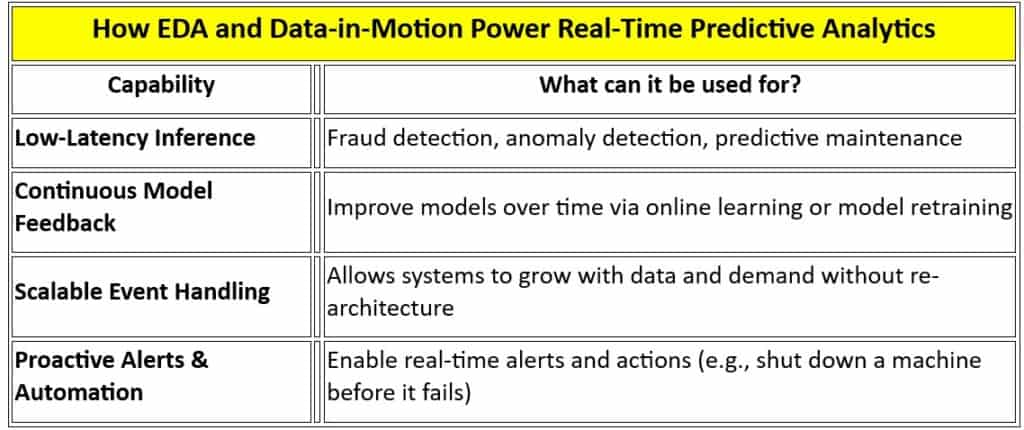
While EDA and data-in-motion are the core technologies that power real-time predictive analytics, other supporting technologies can also play a role. For example, edge computing can further reduce latency by executing models near data sources. Additionally, organizations are utilizing AI to expand the scope of what can be analyzed, thereby extending predictive capabilities to unstructured data, such as text and images.