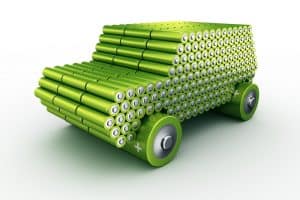
3d rendering of a car made using batteries to show the concept of battery powered cars
As more transport goes electric and more homes become self-sufficient, the need for longer-lasting, denser batteries will become ever greater.
Researchers at the Argonne National Laboratory have built a machine learning model to speed up the process of better battery development. In a paper, published in the August 27 issue of MRS Communications, the team describes the algorithm’s early performance and its capabilities.
Prior to the machine learning model, the researchers had been using a model called G4MP2. It’s an intensive model that uses a lot of computational power, and while highly accurate, would take years to scan all of the 166 billion larger molecules that are potential electrolyte candidates.
SEE ALSO: Case Study: Chuck the Robot Meets the Internet of Things
The new machine learning model is
a compromise, reducing the accuracy somewhat for quicker results. “We
believe that machine learning represents a way to get a molecular picture that
is nearly as precise at a fraction of the computational cost,” said Ian Foster,
Argonne Data Science and Learning division director.
Using the G4MP2 model as a
guideline, the researchers hope to make the machine learning model more
accurate over time. In the future, the new model may be able to mimic many of the
properties of G4MP2, while keeping overhead costs to a minimum.
“This whole project is
designed to give us the biggest picture possible of battery electrolyte
candidates,” said Argonne chemist Rajeev Assary. “If we are going to
use a molecule for energy storage applications, we need to know properties like
its stability, and we can use this machine learning to predict properties of
bigger molecules more accurately.”
As more transport goes electric and more homes become self-sufficient, the need for longer-lasting, denser batteries will become ever greater. However, it is getting more difficult to improve current battery tech, leading many to look for breakthroughs or new formulas. That may be necessary, as current battery development poses massive environmental damage.
David is a technology writer with several years experience covering all aspects of IoT, from technology to networks to security.

 Best Practices for Deploying and Scaling Industrial AIArtificial Intelligence (AI) is transforming industrial operations, helping organizations optimize workflows, reduce downtime, and enhance productivity. Different industry verticals leverage AI in unique ways.Link to The Center for Adaptive Edge Intelligence
 The Center for Adaptive Edge IntelligenceAdaptive edge intelligence brings real-time decision-making to the point of data creation, whether from sensors, machines, or cameras.Link to The Value of Vehicle Electrification
 The Value of Vehicle ElectrificationElectric vehicles (EVs) present automakers with many design, engineering, and manufactu ring challenges.Link to Accelerating Manufacturing Digital Transformation with Industrial Connectivity and IoT
 Accelerating Manufacturing Digital Transformation with Industrial Connectivity and IoTDigital transformation is empowering industrial organizations to deliver sustainable innovation, disruption-proof products and services, and continuous operational improvement.Link to Smart Manufacturing for Automotive
 Smart Manufacturing for AutomotiveLeading a transportation revolution in autonomous, electric, shared mobility and connectivity with the next generation of design and development tools.Link to Center for Data Pipeline Automation
 Center for Data Pipeline AutomationAs businesses become data-driven and rely more heavily on analytics to operate, getting high-quality, trusted data to the right data user at the right time is essential.Link to Center for Automated Integration
 Center for Automated IntegrationThe goal of automated integration is to enable applications and systems that were built separately to easily share data and work together, resulting in new capabilities and efficiencies that cut costs, uncover insights, and much more.Link to Continuous Intelligence: Insights
 Continuous Intelligence: InsightsDigital transformation requires continuous intelligence (CI). Today’s digital businesses are leveraging this new category of software which includes real-time analytics and insights from a single, cloud-native platform across multiple use cases to speed decision-making, and drive world-class customer experiences.